

Custom website vs website builder: when custom development is worth it
A custom website is not automatically better than a website builder.
For many businesses, Webflow or Shopify is the smarter choice. You get a proven editor, hosting, security updates and a platform your team can learn. Paying for custom code to recreate those basics would be expensive and unnecessary.
Custom development becomes worth it when the website stops being a set of pages and starts becoming part of how the business works.
What website builders are good at
A website builder gives you a reliable foundation for common jobs.
Webflow is strong for:
- Marketing websites
- Portfolio and project content
- Restaurants, hospitality and services
- Campaign landing pages
- Design-led sites with frequent content updates
Shopify is strong for:
- Product catalogues
- Online checkout
- Inventory and orders
- Shipping, discounts and payments
- Retail stores selling online and in person
These platforms solve hard, ordinary problems well. That matters. Every standard feature you do not build yourself is one less feature your business has to maintain.
When custom development earns its place
Custom code makes sense when the website needs to model something specific to the business.
Common signs include:
- User accounts with several roles
- Dashboards or secure portals
- Custom calculators and configurators
- Complex search, maps or filtering
- Internal approvals and workflows
- Real-time data from other systems
- A product experience that competitors cannot buy as a template
- Performance requirements a plugin stack cannot meet
At that point, the site is not just communicating the business. It is doing part of the work.
A simple example: when the product is the software
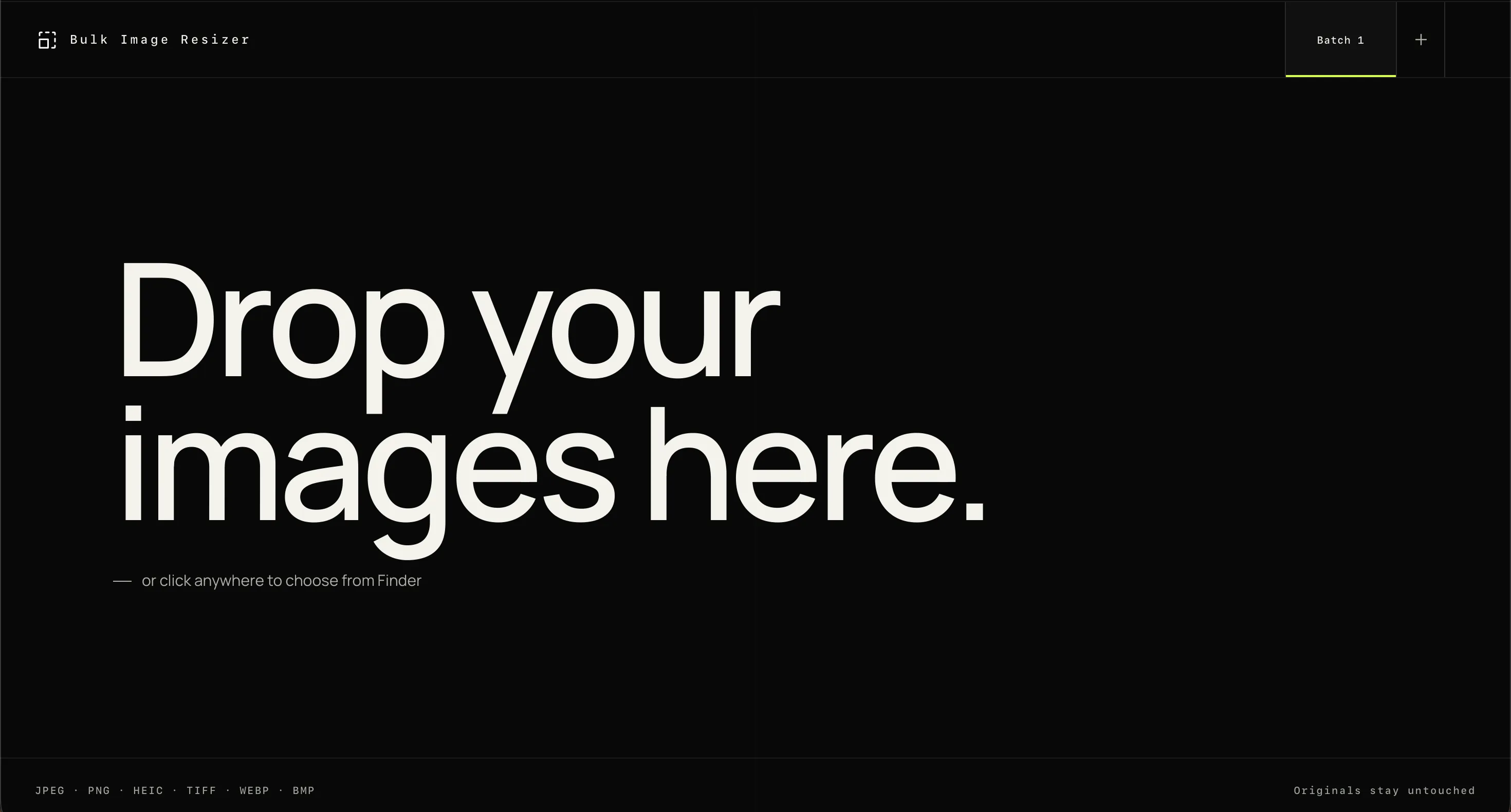
Bulk Image Resizer is a desktop product built with React, TypeScript, Rust and Tauri. The core value is local image processing and a purpose-built workflow.
A page builder could market that product. It could not be the product.
The same distinction applies to websites. A client portal, booking engine, marketplace or data tool may have public pages, but its value lives in the behaviour behind them.
Custom does not have to mean everything is custom
Banff Whisky combines Webflow with Shopify. Webflow controls the brand experience; Shopify handles products and commerce through an API.
That is often better than an all-or-nothing rebuild. Use proven platforms for the parts they already solve, and write custom code around the part that makes the business different.
A good technical decision reduces custom surface area instead of maximizing it.
The real cost difference
A builder usually costs less to launch because the platform already includes hosting, an editor and common features.
Custom development has a higher starting cost and needs an owner after launch. Dependencies change. APIs evolve. Security and monitoring still matter.
The return comes from fit. Custom software can remove manual work, connect systems, create a better customer experience or enable a product that could not exist otherwise.
If it does none of those things, it is probably unnecessary.
Questions to ask before choosing
Ask these in order:
- Is the main job publishing content, selling products or running a workflow?
- Can Webflow or Shopify handle 80 to 90 percent cleanly?
- Is the missing part central to the business or just a preference?
- Will a plugin solve it without creating ongoing maintenance?
- Who will own the system after launch?
- What must be portable if the platform changes?
The answer may be a builder, custom code or a combination.
Choose the simplest system that fits
Choose Webflow when content, design and marketing are the centre of the project.
Choose Shopify when products, checkout and order management are the centre.
Choose custom development when the workflow, data or product behaviour is the centre.
Choose a hybrid when one platform can handle the standard work and custom code can handle the differentiator.
The goal is not to use the most advanced technology. It is to give the business a system it can operate confidently for years.
If you are weighing those options, I can map the requirements before the build starts. Read about web development, Webflow development or Shopify development.