

Shopify for B2B and wholesale: when it fits and when it doesn't
Selling to another business is not the same as selling one product to one person.
A wholesale customer may need their own price list, net payment terms, a purchase-order field, case quantities, repeat ordering and access for several buyers at the same company. That is why a standard online store can feel simple right up until the first serious B2B account arrives.
Shopify's B2B tools are much stronger in 2026 than they used to be. For many wholesalers and manufacturers, Shopify is now a sensible place to start. It is not automatically the right answer for every operation.
What a B2B ecommerce site actually needs
Before choosing a platform, map how an order moves through the business.
A useful B2B store may need:
- Company accounts with more than one buyer or location
- Different products or prices for different customers
- Minimum order quantities and case packs
- Net payment terms, deposits or manual payment methods
- Quick reordering from previous purchases
- Quotes, approvals and purchase orders
- Inventory shared with a retail or direct-to-consumer store
- Connections to accounting, warehouse or ERP software
The important question is not whether a platform has a B2B label. It is whether it fits the way your customers already buy.
When Shopify B2B is a strong fit
Shopify now supports company accounts, customer-specific catalogues, payment terms and other wholesale controls. Some limits and advanced features vary by plan, so the exact setup still needs checking against Shopify's current B2B documentation.
It is a good fit when:
- Your wholesale products are also sold directly to consumers
- Most orders can use a normal product, cart and checkout flow
- Customer groups need different catalogues or prices
- Buyers reorder the same products regularly
- Your team already understands Shopify
- You want one system for products, inventory and orders
The biggest advantage is familiarity. Your staff works in one admin, and customers get a buying experience that feels like a modern online store instead of an emailed spreadsheet.
A real-world way to think about it
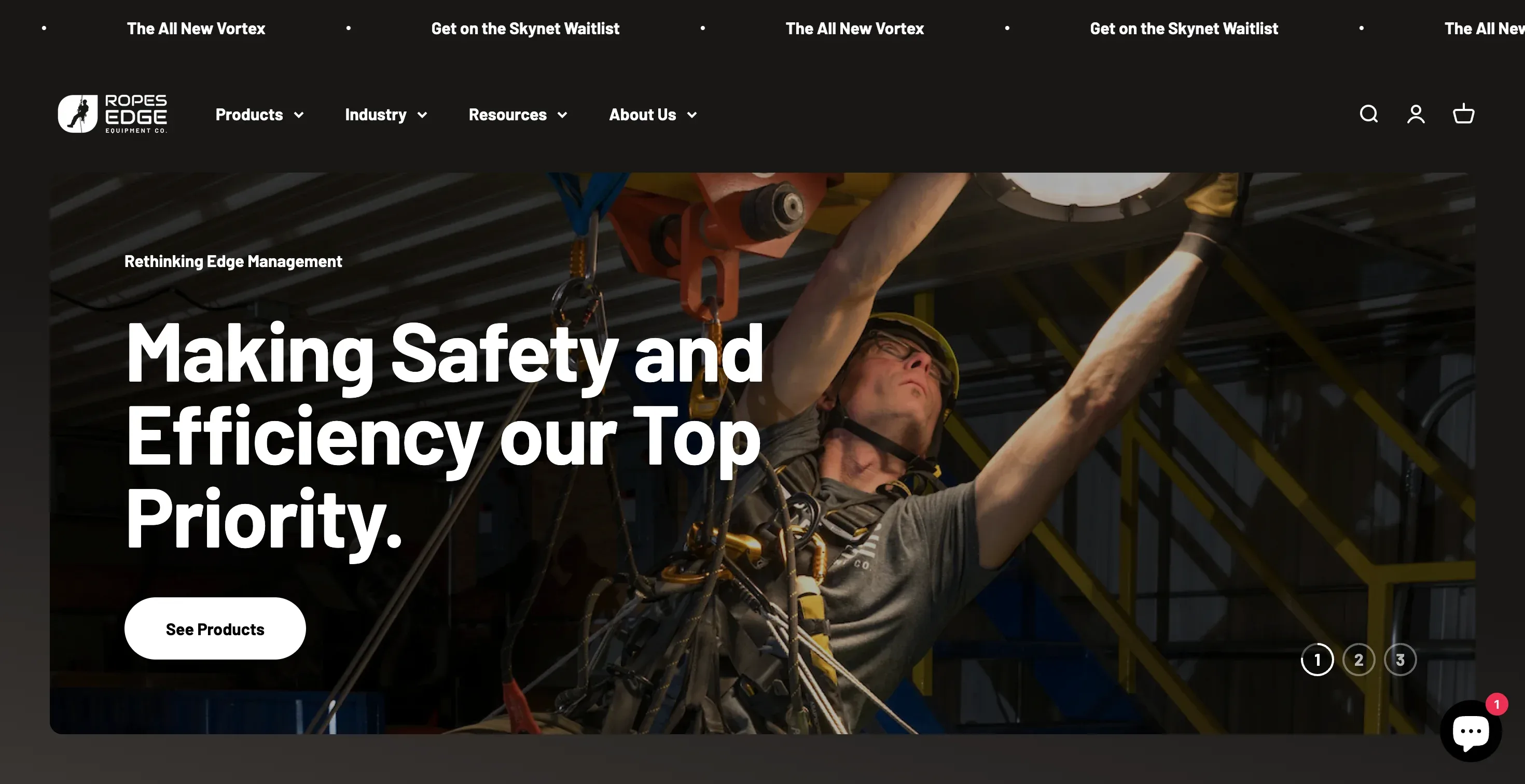
RopesEdge sells technical products to rope-access professionals around the world. Its Shopify store has to make a specialized catalogue feel clear, handle multilingual ecommerce and support customers who already know exactly what they need.
CLS Landscape Supply has a different challenge: bulky products, practical repeat purchases and customers who care more about finding the right material quickly than browsing a lifestyle catalogue.
Neither business should be forced into the same storefront. Shopify provides the commerce foundation, while the product structure and buying flow need to reflect the industry.
When Shopify starts to bend
Custom development becomes worth considering when the order is only one step inside a larger business process.
Watch for requirements like:
- Prices calculated from contracts, locations or live commodity data
- Complex product configurators or engineering rules
- Multi-stage quotes with internal approval
- Customer-specific inventory from an ERP
- Service scheduling tied to the order
- Regulated records or unusual document workflows
- A portal that combines orders, projects, support and reporting
Shopify can connect to outside systems through apps and APIs. The question is how many workarounds your team will have to maintain. If every order depends on custom middleware and manual cleanup, the platform may no longer be simplifying the business.
Shopify, custom code or both?
For many companies, the best answer is both.
Shopify can own products, checkout and orders. Custom code can handle a configurator, customer portal or integration that is unique to the business. That keeps the reliable parts on a proven commerce platform without forcing the unusual parts into a generic template.
A quick decision test
Shopify B2B is probably a strong fit if:
- Customers choose known products from a catalogue
- Pricing rules are understandable and repeatable
- Checkout can handle most orders
- The team wants one commerce admin
- Integrations are common and well supported
Talk about custom development if:
- The product must be calculated or configured
- Every account has a different workflow
- Quotes matter more than checkout
- Several internal systems must agree in real time
- The portal itself is part of what customers are buying
If you are planning a wholesale store, I can help map the buying process before anyone chooses the platform. Read more about my work as a Shopify developer or with custom web development.